Study of fairy story origins traces some back thousands of years, with one tale dating back as far as bronze age.
Monday, January 25, 2016
This concept of self-enjoyment does not exhaust that aspect of process here termed 'life'. Process for its intelligibility involves the notion of a creative activity belonging to the very essence of each occasion. It is the process of eliciting into actual being factors in the universe which antecedently to that process exist only in the mode of unrealized potentialities. The process of self-creation is the transformation of the potential into the actual, and the fact of such transformation includes the immediacy of self-enjoyment.
Thus in conceiving the function of life in an occasion of experience, we must discriminate the actualized data presented by the antecedent world, the non-actualized potentialities which lie ready to promote their fusion into a new unity of experience, and the immediacy of self-enjoyment which belongs to the creative fusion of those data with those potentialities. This is the doctrine of the creative advance whereby it belongs to the essence of the universe, that it passes into a future. It is nonsense to conceive of nature as a static fact, even for an instant devoid of duration. There is no nature apart from transition, and there is no transition apart from temporal duration. This is the reason why the notion of an instant of time, conceived as a primary simple fact, is nonsense.
But even yet we have not exhausted the notion of creation which is essential to the understanding of nature. We must add yet another character to our description of life. This missing characteristic is 'aim'. By this term 'aim' is meant the exclusion of the boundless wealth of alternative potentiality, and the inclusion of that definite factor of novelty which constitutes the selected way of entertaining those data in that process of unification. The aim is at that complex of feeling which is the enjoyment of those data in that way. 'That way of enjoyment' is selected from the boundless wealth of alternatives. It has been aimed at for actualization in that process.
Thus the characteristics of life are absolute self-enjoyment, creative activity, aim. Here 'aim' evidently involves the entertainment of the purely ideal so as to be directive of the creative process. Also the enjoyment belongs to the process and is not a characteristic of any static result. The aim is at the enjoyment belonging to the process.
The question at once arises as to whether this factor of life in nature, as thus interpreted, corresponds to anything that we observe in nature. All philosophy is an endeavor to obtain a self-consistent understanding of things observed. Thus its development is guided in two ways, one is the demand for a coherent self-consistency, and the other is the elucidation of things observed. It is therefore our first task to compare the above doctrine of life in nature with our direct observations. (208 - 209, Nature Lifeless, Whitehead)
If you say, ‘Isn ’ t life the answer?’ to the question what
a body can do, the answer is ‘Yes’. But you have to make
life an adverb: lively. It ’ s about liveliness or liveness.
There is no life substance. Life is not a thing. Life is the
way in which the mental and physical poles of events
come together – differently every time, always under
singular circumstances, moving in the general direction
of the accumulation in the world of differences, of
improvised novelty. Whitehead says that life is in the
intervals between things – in the way things relate, in
the way they come together in events under the dominant
tendency towards the generation of new forms, or
ontogenesis.
The tendency towards ontogenesis cannot operate
without the contrasting tendency towards homeostasis.
Life can ’ t always live at the limit. It can ’ t continue to
survive if it is always pushing to the limit of intensity,
creating new forms. It needs a degree of stability, oases
of rest. It cannot be chaotically far-from-equilibrium at
all times. It has to fi nd its footing, to brace itself for new
becomings. This means that life is the movement between
the mental and physical poles, between conformation
and supernormal excess, between one event and another,
between all of the various factors in play. Life lives inthe gaps. Still, what I just called the supernormal tendency,
corresponding to the mental pole, is the dominant
tendency. Life is biased in its direction – otherwise
it would not be so changeable. We wouldn ’ t have the
exuberant proliferation of forms that we see in nature
and in culture.
Arno Boehler: In the workshop you uttered the claim
that contemporary philosophers have to construct a
relational form of logic to think this ‘liveliness’ and
thereby deconstruct the classical binary form of logic?
Brian Massumi: To stay for a moment with the question
of life, I would say that a life is not an in-itself, it ’ s an
outdoing-itself. In other words, it follows a tendency to
exceed already-realized potential in an actualization of
new potential. That process, as you said, is relational.
In order to think relation as primary, we need a different
kind of logic, because the traditional logic is one of
separation. Traditionally, the basic logical gesture is to
separate X from not- X , and then defi ne the common
characteristics justifying inclusion of a given case in
the set of X ’ s. It starts with exclusion and ends in sameness.
That doesn ’ t get you to a process of outdoingitself.
It gets you to a stable structure of thought that
cannot move. If you try to undo that logic, you have to
accept that you cannot operate with the principle of the
excluded middle – X or not- X . But you also have to
go beyond deconstructing that exclusionary logic. You
have to go on to affi rm a more encompassing logic that
is able to deal with what I call ‘mutual inclusion’. When
you get to that territory, you fi nd that it ’ s mined with
paradoxes that you cannot avoid. You have to fi gure
out how to make them productive. In that logic there
are more terms than X and non- X , because of the
included middle.
(184 - 185, What a Body can do, Massumi),
At the beginning of the modern period Descartes expresses this dualism with the utmost distinctness. For him, there are material substances with spatial relations, and mental substances. The mental substances are external to the material substances. Neither type requires the other type for the completion of its essence. Their unexplained interrelations are unnecessary for their respective existences. In truth, this formulation of the problem in terms of minds and matter is unfortunate. It omits the lower forms of life, such as vegetation and the lower animal types. These forms touch upon human mentality at their highest, and upon inorganic nature at their lowest.
The effect of this sharp division between nature and life has poisoned all subsequent philosophy. Even when the coördinate existence of the two types of actualities is abandoned, there is no
proper fusion of the two in most modern schools of thought. For some, nature is mere appearance and mind is the sole reality. For others, physical nature is the sole reality and mind is an epiphenomenon. Here the phrases 'mere appearance' and 'epiphenomenon' obviously carry the implication of slight importance for the understanding of the final nature of things.
The doctrine that I am maintaining is that neither physical nature nor life can be understood unless we fuse them together as essential factors in the composition of 'really real' things whose interconnections and individual characters constitute the universe.
The first step in the argument must be to form some concept of what life can mean. (205, Nature Lifeless, Whitehead)
Science can find no individual enjoyment in nature: Science can find no aim in nature: Science can find no creativity in nature; it finds mere rules of succession. These negations are true of Natural Science. They are inherent in its methodology. The reason for this blindness of Physical Science lies in the fact that such Science only deals with half the evidence provided by human experience. It divides the seamless coat—or, to change the metaphor into a happier form, it examines the coat, which is superficial, and neglects the body which is fundamental. (212 Nature Lifeless, Whitehead)
Surplus-value of life is not given and it is not found. It is created.
A value is not just refl ective of the character
of an event. It becomes a key factor in the generation
of events that express potential, and that forward it on
to subsequent events. A value, once emerged, remains
as an attractor for other events to come. It is that
forward-pulling attractive force towards the recurrence
of a mode of coming-together-for-expression that defi nes
an existential value.
An existential value is a surplus-value of life, in the
sense that it carries a force of extra-being, of becoming.
A surplus-value of life is always collective, but not in a
sense of a simple aggregation of individuals as countable
elements of a set. It is collective in that truly transindividual
sense in which things come into supernumerary
relation with each other through the potentials they
activate, and surpass themselves in a joint movement
constituting the dynamic unity of their differential. The
collective is not just an aggregate of individuals. It is a
co-individuation. For that reason, Simondon always
uses the term collective individuation.
(201, What a body can do, Massumi)
[….] (226) Consider our notion of 'causation'. How can one event be the cause of another? In the first place, no event can be wholly and solely the cause of another event. The whole antecedent world conspires to produce a new occasion. But some one occasion in an important way conditions the formation of a successor. How can we understand this process of conditioning?
The mere notion of transferring a quality is entirely unintelligible. Suppose that two occurrences may be in fact be detached so that one of them is comprehensible without reference to the other. Then all notion of causation between them, or of conditioning, becomes unintelligible. There is—with this supposition—no reason why the possession of any quality by one of them should in any way influence the possession of that quality, or of any other quality, by the other. With such a doctrine the play and interplay of qualitative succession in the world becomes a blank fact from which no conclusions can be drawn as to past, present, or future, beyond the range of direct observation. Such a positivistic belief is quite self-consistent, provided that we do not include in it any hopes for the future or regrets for the past. Science is then without any importance. Also effort is foolish, because it determines nothing. The only intelligible doctrine of causation is founded on the doctrine of immanence. Each occasion presupposes the antecedent world as active in its own nature. This is the reason why events have a determinate status relatively to each other. Also it is the reason why the qualitative energies of the past are combined into a pattern of qualitative energies in each present occasion. This is the doctrine of causation. It is the reason why it belongs to the essence of each occasion that it is where it is. It is the reason for the transference of character from occasion to occasion. It is the reason for the relative stability of laws of nature, some laws for a wider environment, some laws for a narrower environment. It is the reason why —as we have already noted—in our direct apprehension of the world around us we find that curious habit of claiming a two-fold unity with the observed data. We are in the world and the world is in us. Our immediate occasion is in the society of occasions forming the soul, and our soul is in our present occasion. The body is ours, and we are an activity within our body. This fact of observation, vague but imperative, is the foundation of the connexity of the world, and of the transmission of its types of order. (226-227 Nature Lifeless, Whitehead)
Anthropocentrism and the false Nature/Human dichotomy
This is just a quick post because I noticed something nonsensical while perusing Wikipedia.
I found an interspecies friendship article https://en.wikipedia.org/wiki/Interspecies_friendship that does not bother to discuss the relationships between humans and animals in the article itself, it simply links to an article about human-canine bonds. What would Donna Haraway think of this?!
But seriously, I am sure there are articles that deal with human-animal relationships, I just thought it was a funny piece of anthropocentricism that whoever authored this page did not consider humans a 'species'.
Correspondingly, a google image search for "interspecies friendship" fails to turn up many human/non-human animal friendships in the first few pages of results! Just one little kitty attached to an ankle- nonetheless, makes for very pleasant research!
That's all for now!
I found an interspecies friendship article https://en.wikipedia.org/wiki/Interspecies_friendship that does not bother to discuss the relationships between humans and animals in the article itself, it simply links to an article about human-canine bonds. What would Donna Haraway think of this?!
But seriously, I am sure there are articles that deal with human-animal relationships, I just thought it was a funny piece of anthropocentricism that whoever authored this page did not consider humans a 'species'.
Correspondingly, a google image search for "interspecies friendship" fails to turn up many human/non-human animal friendships in the first few pages of results! Just one little kitty attached to an ankle- nonetheless, makes for very pleasant research!
That's all for now!
Saturday, January 23, 2016
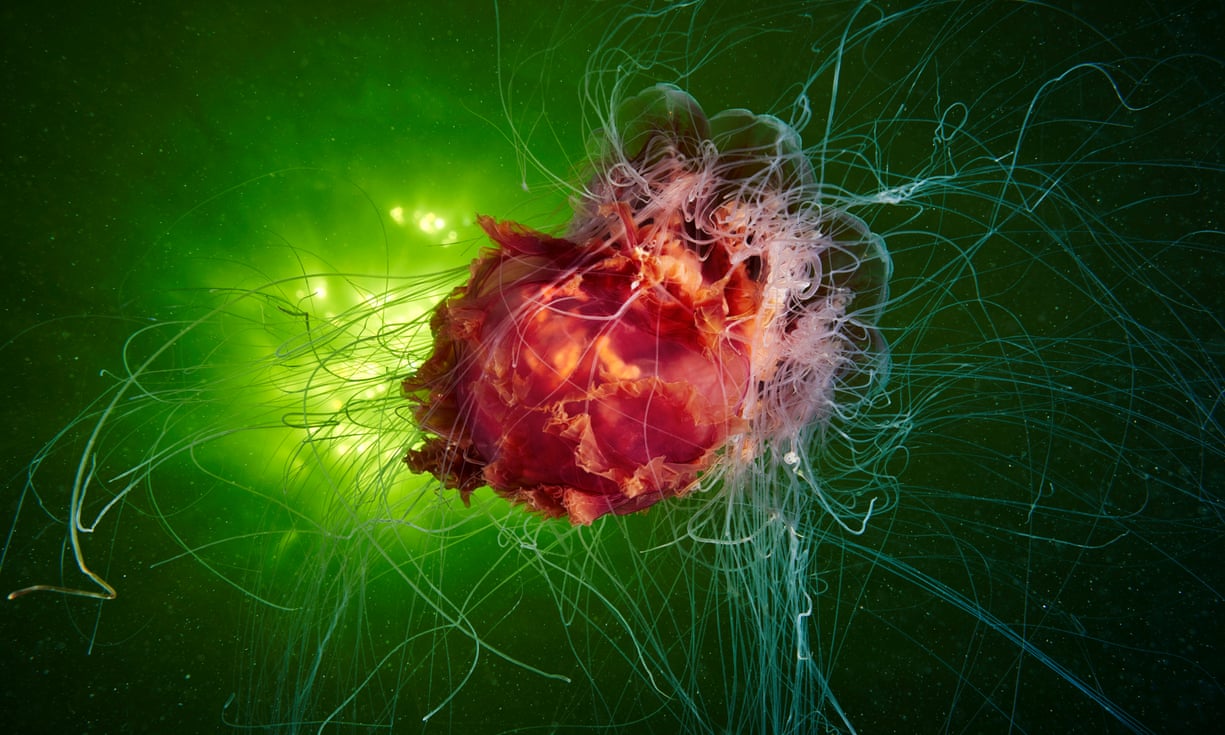
Jelly-legs
http://www.theguardian.com/environment/2016/jan/10/marine-life-alexander-semenov-jellyfish
http://www.theguardian.com/environment/2015/dec/29/jellyfish-flourish-but-wasps-wobble-in-year-of-climate-confusion

Some thoughts on jellyfish:
Over the break I was stung on the back of the legs. Either by a jelly or by some anenomes that I brushed up against under a dock.
Please forgive me for rubbing my jelly-tropical-vacation in your faces and all over this blog. I promise you there is a relevance to class.
It burned and stang, and I couldn't quite believe it was happening. After looking on my phone and with my sister's help, I diagnosed the hives as form of fibreglass rash.... That was until a week ago, back in montreal, in the cold, and white, they returned. The itchy tentacle pattern is back on my legs. I am one with the jelly. I am part jelly.
According to the news, climate change means that it's been a good year for jellyfish. A Guardian heading from August 21st 2015 urges us to consider "Like a karmic device come to punish our planetary transgressions, jellyfish thrive on the environmental chaos humans create. Is the age of the jellyfish upon us?"
As it turns out this kind of delayed sensitivity, or delayed reaction which I'm experiencing is common. But the effect of this venom on humans is not very well understood. WebMD says this kind of thing can last for few months. And strike again, repeatedly. In fact it was this this line of inquiry about how long will I be itchy, how to stop itchy, why me, and what is the effect of sea anenome venom, that I learnt about the history of anaphylaxis. It was discovered by Charles Richet and Paul Portier who had been experimenting with the toxicity of sea anenome venom on dogs. http://www.ncbi.nlm.nih.gov/pubmed/14989211
In 1901, during one of his oceanography cruises, Prince Albert the First of Monaco asks Paul Portier and Charles Richet to study the toxicity of small jellyfish fishing filaments (Coelentera). In the course of their work on the effects of a hypnotoxin extracted from various coelentera, they observe mortal accidents that are not a function of the dosage of the injections. Dogs that respond this way have all received a preparative injection, yet some dogs have no reaction to a second injection. In contrast the injection are activating when they occur more than 10 to 12 days after the first. This phenomenon is independent of the administered dosage, which may well be inferior to a toxic quantity. They call this phenomenon anaphylaxis, the contrary of protection, and analyze its primary characteristics. Paul Portier eventually returns to the Faculty of Sciences where he is Dastre's assistant. Charles Richer pursues research on anaphylaxis on his own in his laboratory at the Medical Faculty. By showing that an immune response could be pathogen as well as healing, these two scientists - who did not know each other before, working together for a few short months - made a discovery that opened up new venues in the growing field of medical immunology.
All this is to say is that jellyfish may be a good starting point for me to consider the anthropocene and affect. What can we learn from jellyfish? How can we conceive of a jellybody thinking? How is it that the jellyfish has left a mark on my legs? How is it that my body still reacts as if the jellyfish is still there? What is a supernormal stimulus? Supernomal excess?
http://www.theguardian.com/environment/2015/dec/29/jellyfish-flourish-but-wasps-wobble-in-year-of-climate-confusion

Some thoughts on jellyfish:
Over the break I was stung on the back of the legs. Either by a jelly or by some anenomes that I brushed up against under a dock.
Please forgive me for rubbing my jelly-tropical-vacation in your faces and all over this blog. I promise you there is a relevance to class.
It burned and stang, and I couldn't quite believe it was happening. After looking on my phone and with my sister's help, I diagnosed the hives as form of fibreglass rash.... That was until a week ago, back in montreal, in the cold, and white, they returned. The itchy tentacle pattern is back on my legs. I am one with the jelly. I am part jelly.
According to the news, climate change means that it's been a good year for jellyfish. A Guardian heading from August 21st 2015 urges us to consider "Like a karmic device come to punish our planetary transgressions, jellyfish thrive on the environmental chaos humans create. Is the age of the jellyfish upon us?"
As it turns out this kind of delayed sensitivity, or delayed reaction which I'm experiencing is common. But the effect of this venom on humans is not very well understood. WebMD says this kind of thing can last for few months. And strike again, repeatedly. In fact it was this this line of inquiry about how long will I be itchy, how to stop itchy, why me, and what is the effect of sea anenome venom, that I learnt about the history of anaphylaxis. It was discovered by Charles Richet and Paul Portier who had been experimenting with the toxicity of sea anenome venom on dogs. http://www.ncbi.nlm.nih.gov/pubmed/14989211
Hist Sci Med. 2003 Oct-Dec;37(4):463-9.
[The discovery of anaphylaxis, a brief but triumphant encounter of two physiologists (1902)].
[Article in French]
Abstract
All this is to say is that jellyfish may be a good starting point for me to consider the anthropocene and affect. What can we learn from jellyfish? How can we conceive of a jellybody thinking? How is it that the jellyfish has left a mark on my legs? How is it that my body still reacts as if the jellyfish is still there? What is a supernormal stimulus? Supernomal excess?
I found this talk by physicist and philosopher Karen Barad akin to ideas of relationality and affect in Massumi's and Whitehead's texts (the ones I've read).
I wish to note that Barad refers to a level of observation specific to physics and that such is not the same as the social, cultural, or even that of other hard sciences, levels of observation. Thus, overgeneralizing is rushing into determination.
Nonetheless, I find here points on agential realism, intraction, and Niels Bohr point of "concepts are specific material arrangements", insightful and useful to consider the use or dismissal of categories.
https://www.youtube.com/watch?v=cS7szDFwXyg
I wish to note that Barad refers to a level of observation specific to physics and that such is not the same as the social, cultural, or even that of other hard sciences, levels of observation. Thus, overgeneralizing is rushing into determination.
Nonetheless, I find here points on agential realism, intraction, and Niels Bohr point of "concepts are specific material arrangements", insightful and useful to consider the use or dismissal of categories.
Updates on the Exxon Climate Change Cover-up
Yesterday California Attorney General, Kamala Harris, launched a criminal investigation against ExxonMobil following suit of New York's investigation launched in November 2015 after accusation that scientists employed by the oil company have known about the effects of climate change as early as the 1970s. Rather than release the reports, Exxon has lied to the public and poured millions into climate change denial propaganda. While I imagine most of the class is familiar with this budding media scandal, Democracy Now released a comprehensive overview of the story on December 31st, 2015 to bemoan the troubling news the 2015 was the warmest year on record. It can be viewed here: http://www.democracynow.org/2015/12/31/exxons_climate_cover_up_just_got
As I consider these updates in the context of our project of affectively considering what it means to be human participants in the anthropocene -- how we might 'become geological' to grapple with our participation, or at least our complicity, in our species' violent attacks on the environment -- I'm interested in this course of action, that is, the criminalization of climate change cover-up. How might this very human system of legality be used geologically? Can it at all?
Wednesday, January 20, 2016
Fairytales making sense of our relationship with the natural world
I am sharing this article because I feel a link between affect theories we are reading on, narratives and the human efforts to explain its relationship with nature, and to hold on/invite nature/the animal world/the environment to remain part of a larger narrative, which a human is part of. I appreciate the method of dating folk stories through languages, cultural parameters, and geological cartography.
Is it possible that in time, folks stories 'wrote in' specific entities with specific bodies, which in earlier time had a lesser specific body, and a more porous / inter-species image? Is it possible that mutual inclusiveness speaks of bodies as a shared stories-body?
The humanization of folk characters seems to point to an evolution of body specificity with time.
~cricri
Fairytales making sense of our relationship with the natural world
Fairy stories such as Beauty and the Beast and Rumpelstiltskin can be
traced back thousands of years to prehistoric times, with one tale
originating from the bronze age, academics have revealed.
Using techniques normally employed by biologists, they studied common links between 275 Indo-European fairy tales from around the world and found some have roots that are far older than previously known, and “long before the emergence of the literary record”.
While stories such as Beauty and the Beast and Rumplestiltskin were first written down in the 17th and 18th century, the researchers found they originated “significantly earlier”. “Both tales can be securely traced back to the emergence of the major western Indo-European subfamilies as distinct lineages between 2,500 and 6,000 years ago,” they write.
Durham University anthropologist Dr Jamie Tehrani, who worked with folklorist Sara Graça da Silva, from New University of Lisbon, believed the research – published in the Royal Society Open Science journal – has answered a question about our cultural heritage.
In the 19th century Wilhelm Grimm, of the Brothers Grimm, believed many of the fairy stories they popularised were rooted in a shared cultural history dating back to the birth of the Indo-European language family.
But later thinkers challenged that view, saying some stories were much younger, and passed into oral tradition having first been written down by writers from the 16th and 17th centuries.
Da Silva told the Guardian that the origin of folk tales was one of the “biggest mysteries” in folk tale studies, with its reconstruction “often frustrated not only by difficulties in defining the genre but also as a result of the rich interplay between oral and written traditions”. The new method of mapping the stories through common languages and geographical proximity worked, “because in oral tradition, folk tales are transmitted through spoken language, so a correlation might be expected; and also because both languages and folk tales are transmitted from generation to generation.”
Tehrani said their study agreed with Grimm’s theory: “Some of these stories go back much further than the earliest literary record and indeed further back than classical mythology – some versions of these stories appear in Latin and Greek texts – but our findings suggest they are much older than that.”
Analysis showed Jack and the Beanstalk was rooted in a group of stories classified as The Boy Who Stole Ogre’s Treasure, and could be traced back to when eastern and western Indo-European languages split – more than 5,000 years ago. Beauty and the Beast and Rumpelstiltskin to be about 4,000 years old. A folk tale called The Smith and the Devil was estimated to date back 6,000 years to the bronze age.
The story, which involves a blacksmith selling his soul in a pact with the devil in order to gain supernatural ability, then tricking the evil power, is not so well known today, but its theme of a Faustian pact is familiar to many.
The study employed phylogenetic analysis, which was developed to investigate evolutionary relationships between species, and used a tree of Indo-European languages to trace the descent of shared tales on it, to see how far they could be demonstrated to go back in time.
Tehrani said: “We find it pretty remarkable these stories have survived without being written. They have been told since before even English, French and Italian existed. They were probably told in an extinct Indo-European language.”
Da Silva believes the stories endure thanks to “the power of storytelling and magic from time immemorial”.
“Besides, the motifs present in fairytales are timeless and fairly universal, comprising dichotomies such as good and evil; right and wrong, punishment and reward, moral and immoral, male and female,” she added. “Ultimately, despite being often disregarded as fictitious, and even as a lesser form of narrative, folk tales are excellent case studies for cross-cultural comparisons and studies on human behaviour, including cooperation, decision making, [and so on].”
The author and academic Marina Warner, who has written a history of fairytales, called the paper “fascinating”. “What’s interesting to me is it shows how deeply this creative power of the imagination lies in the human being, how it’s about making sense of your world by inventing narratives that resist its difficulties,” she said. “In the case of The Smith and the Devil, it’s a cunning tale – the trickster tricked, showing a very ancient version of that defiance of difficulty. That capricious chance will play tricks on you, but you, with cunning, will be able to resist that. It’s a kind of joke the audience shares to feel a little better.”
Beauty and the Beast, or The Animal Bride, shows a similar kind of imagining, she added. “It’s making sense of our relationship with the natural world - eliminating the threat. A beast figure marries a woman, and then the stories take different turns; in one she kills him, in one she finds he turns into a man when she kisses him.”
Press Association contributed to this report.
Is it possible that in time, folks stories 'wrote in' specific entities with specific bodies, which in earlier time had a lesser specific body, and a more porous / inter-species image? Is it possible that mutual inclusiveness speaks of bodies as a shared stories-body?
The humanization of folk characters seems to point to an evolution of body specificity with time.
~cricri
Fairytales making sense of our relationship with the natural world
Fairytales much older than previously thought, say researchers
![]() |
| Illustration of Beauty and the Beast, one of the fairytales believed to date from thousands of years ago. Photograph: Durham University/PA |
Using techniques normally employed by biologists, they studied common links between 275 Indo-European fairy tales from around the world and found some have roots that are far older than previously known, and “long before the emergence of the literary record”.
While stories such as Beauty and the Beast and Rumplestiltskin were first written down in the 17th and 18th century, the researchers found they originated “significantly earlier”. “Both tales can be securely traced back to the emergence of the major western Indo-European subfamilies as distinct lineages between 2,500 and 6,000 years ago,” they write.
Durham University anthropologist Dr Jamie Tehrani, who worked with folklorist Sara Graça da Silva, from New University of Lisbon, believed the research – published in the Royal Society Open Science journal – has answered a question about our cultural heritage.
In the 19th century Wilhelm Grimm, of the Brothers Grimm, believed many of the fairy stories they popularised were rooted in a shared cultural history dating back to the birth of the Indo-European language family.
But later thinkers challenged that view, saying some stories were much younger, and passed into oral tradition having first been written down by writers from the 16th and 17th centuries.
Da Silva told the Guardian that the origin of folk tales was one of the “biggest mysteries” in folk tale studies, with its reconstruction “often frustrated not only by difficulties in defining the genre but also as a result of the rich interplay between oral and written traditions”. The new method of mapping the stories through common languages and geographical proximity worked, “because in oral tradition, folk tales are transmitted through spoken language, so a correlation might be expected; and also because both languages and folk tales are transmitted from generation to generation.”
Tehrani said their study agreed with Grimm’s theory: “Some of these stories go back much further than the earliest literary record and indeed further back than classical mythology – some versions of these stories appear in Latin and Greek texts – but our findings suggest they are much older than that.”
Analysis showed Jack and the Beanstalk was rooted in a group of stories classified as The Boy Who Stole Ogre’s Treasure, and could be traced back to when eastern and western Indo-European languages split – more than 5,000 years ago. Beauty and the Beast and Rumpelstiltskin to be about 4,000 years old. A folk tale called The Smith and the Devil was estimated to date back 6,000 years to the bronze age.
The story, which involves a blacksmith selling his soul in a pact with the devil in order to gain supernatural ability, then tricking the evil power, is not so well known today, but its theme of a Faustian pact is familiar to many.
The study employed phylogenetic analysis, which was developed to investigate evolutionary relationships between species, and used a tree of Indo-European languages to trace the descent of shared tales on it, to see how far they could be demonstrated to go back in time.
Tehrani said: “We find it pretty remarkable these stories have survived without being written. They have been told since before even English, French and Italian existed. They were probably told in an extinct Indo-European language.”
Advertisement
“Besides, the motifs present in fairytales are timeless and fairly universal, comprising dichotomies such as good and evil; right and wrong, punishment and reward, moral and immoral, male and female,” she added. “Ultimately, despite being often disregarded as fictitious, and even as a lesser form of narrative, folk tales are excellent case studies for cross-cultural comparisons and studies on human behaviour, including cooperation, decision making, [and so on].”
The author and academic Marina Warner, who has written a history of fairytales, called the paper “fascinating”. “What’s interesting to me is it shows how deeply this creative power of the imagination lies in the human being, how it’s about making sense of your world by inventing narratives that resist its difficulties,” she said. “In the case of The Smith and the Devil, it’s a cunning tale – the trickster tricked, showing a very ancient version of that defiance of difficulty. That capricious chance will play tricks on you, but you, with cunning, will be able to resist that. It’s a kind of joke the audience shares to feel a little better.”
Beauty and the Beast, or The Animal Bride, shows a similar kind of imagining, she added. “It’s making sense of our relationship with the natural world - eliminating the threat. A beast figure marries a woman, and then the stories take different turns; in one she kills him, in one she finds he turns into a man when she kisses him.”
Press Association contributed to this report.
Subscribe to:
Comments (Atom)