http://revistaarta.ro/en/the-power-of-co-in-contemporary-dance/
it really moves-with a lot of the notions that Brian Massumi's text was working through;
questions around creativity, excess, for example, co-imagination being in the world: "co-imagination must always be affirmed as operating beyond (or besides)
the notion of the subject. This is why I insist on the “co-“, to
emphasize it is always intersubjective, transindividual, or better
still: totally impersonal. And it also operates beyond any
accountability of the senses (therefore making it be about a logic of
sensation to use Deleuze’s expression)."
or non-sensual perception as: "affects are expressed and transmitted in ways that completely bypass
visual macro-perceptions; affects and sensations arrive to us faster
than the eye can process. And there are also elements that are absolutely choreographic and yet
absolutely non-visual. Including how specific dance works give
themselves to full visibility only because they are directly addressing
other works, artists, or events that are truly not there, but their not being there is what nevertheless grounds the possibility of that particular work to exist – now."(similar to the Kanizsa triangle)
and so on.
interesting read, also for his move from phenomenology towards process philosophy in the previous years (although still with reminiscents of subjectivity and linear time:) and for the fact that this discourse is happening in Bucharest: awesome
Wednesday, January 20, 2016

Monday, January 18, 2016
"Earth's biggest living thing might be a tree with thousands of clones"
From http://www.pri.org/stories/2015-05-05/earths-biggest-living-thing-might-be-tree-thousands-clones, maybe an example of a non-human communication system through the roots of the "biggest living organism in Earth":
Earth's biggest living thing might be a tree with thousands of clones

A photo of Pando in the fall at Fish Lake National Forest.
The largest organism on Earth probably isn't a whale or a giant octopus or anything else you might naturally think of first. It's a tree — or a group of genetically identical trees that stretches across more than 100 acres of Utah's Fishlake National Forest.
Called "Pando," which is Latin for “I spread," the group of quaking aspens is considered one of the largest — by area — and most massive living organisms on earth. The quaking aspen, found from coast to coast across North America, grows in groups called stands. Within these stands, a single tree will spread by sprouting new stems from its roots, often several feet from the original trunk.
“Those trees remain connected for a good long while,” explains Jennifer DeWoody, a geneticist with the US Forest Service. “This long process is over many years — suckers [or stems] coming up over a larger and larger area.” Their stems can share the products of photosynthesis, food, and possibly disease as well.
Because individual aspen stems generally live about 100-150 years, DeWoody says the origin mother stem is likely dead: “The only way the whole clone survives is to send up new suckers,” she says. While other trees can also clone in this way, “[aspens] do it the most broadly across so many different environments.”
Pando is unique because its stand is so massive compared to most others. University of Colorado scientists estimated in 1976 that it contained around 47,000 stems. Those scientists were also the first to describe Pando as a clone, based off of morphologic and aerial photographic analysis. But it wasn’t until 2008 that DeWoody and researchers from Utah State University confirming that Pando indeed was a single genetic individual, by collecting leaf and bark samples from the trees and analyzing their DNA.
Estimates say Pando’s genetic makeup could be anywhere from 80,000 to one million years old — “that’s a very hard thing to measure,” DeWoody says. But based on analyses of how long it takes aspens to grow and to sprout, scientists agree Pando is extremely old, if not one of earth’s most ancient organisms.
Yet aspens haven’t been growing very much in the West in recent years. “These little aspen sucklings are really tasty to things like elk and deer,” DeWoody says, and in the case of Pando, “for a long time, there were no new stems coming up because they were being grazed really heavily.” Foresters have been putting up fences to keep the animals out, and have also been cutting some trees to stimulate new growth.
The best time to see Pando, DeWoody says, is when summer shifts into fall. “Aspens are really great because they’re one of the first things to turn color.” The quaking aspens — also known as trembling aspens because their leaves catch the breeze in such a way that makes the trees look like they’re shaking — turn a brilliant gold in the fall. In the West especially, it’s one of the only trees that changes color like that.
“It’s a great example of some of the wonders that are out on your national lands, your public lands,” DeWoody says. “So go visit your national forests!”
This story was originally published by PRI's Science Friday with Ira Flatow.
And as said in another website, maybe it's dying - an Anthropocene consequence, maybe?
In tangent to a conversation around "how the concept of thinking is different to how we usually think it; that there is a strong re-orientation of what it means to think, when affect and 'capacities' and body-ing are engaged:
"not what a body is, but what a body can do - capacities to think. it's a capacity , it's a doing."
"not what a body is, but what a body can do - capacities to think. it's a capacity , it's a doing."
"Can a body think?’ If you define mentality as Whitehead does – as the capacity to exceed what is given and to bring forth a novelty – then an improvisational variation playing on an instinctive activity, even in an animal without a brain, shows a certain degree or mode of mentality. This conception of mentality breaks down the Cartesian distinction between the mental and the physical, but without simply collapsing them into each other, or bracketing one out. It forces you to rethink how you define the physical and the mental, how you parse them together." - 178-179, "What a body can do"
Slime mold: has no central nervous system, has no brain, and is entirely unicellular. Yet its vibratory bodying capacities improvise and problem solve in relation. Memory is activatd-- but not within the bounds of 'thinking' that is usually taken up, in and outside of science.

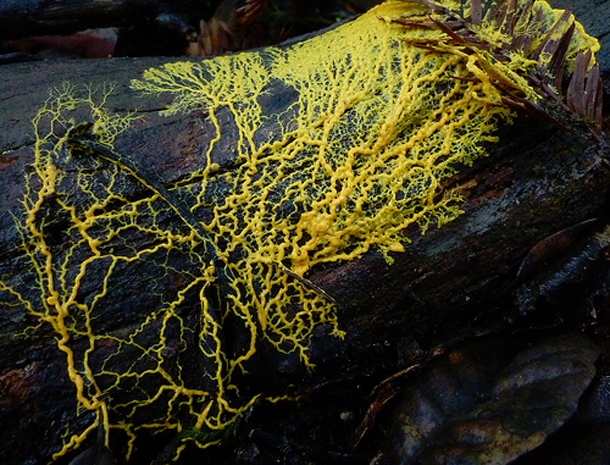
basic introduction via nature.com
Learning and memory — abilities associated with a brain or, at the very least, neuronal activity — have been observed in protoplasmic slime, a unicellular organism with multiple nuclei.
When the amoeba <i>Physarum polycephalum</i> is subjected to a series of shocks at regular intervals, it learns the pattern and changes its behaviour in anticipation of the next one to come1, according to a team of researchers in Japan. Remarkably, this memory stays in the slime mould for hours, even when the shocks themselves stop. A single renewed shock after a 'silent' period will leave the mould expecting another to follow in the rhythm it learned previously. Toshiyuki Nakagaki of Hokkaido University in Sapporo and his colleagues say that their findings "hint at the cellular origins of primitive intelligence".
It is well-established that cells receive, interpret and adjust to environmental fluctuations, says microbiologist James Shapiro of the University of Chicago, Illinois. But if the results stand up, he says, "this paper would add a cellular memory to those capabilities".
The organism chosen by the Japanese team could scarcely seem less promising as a quick learner. <i>Physarum polycephalum</i> is a slime mould belonging to the Amoebozoa phylum. It moves at a steady rate of about one centimetre per hour at room temperature, but this changes with the humidity of its environment. It slows down in drier air, and Nakagaki's team used this sensitivity to stimulate learning.
The team found that when the mould experienced three episodes of dry air in regular succession an hour apart, it apparently came to expect more: it slowed down when a fourth pulse of dry air was due, even if none was actually applied. Sometimes this anticipatory slow-down would be repeated another hour later, and even a third. The same behaviour was seen when the pulses were experienced at other regular time intervals — say, every half hour or every 1.5 hours.
If the dry episodes did not recur after the first three, the amoeba's sense of expectation gradually faded away. But then applying a single dry pulse about six hours later commonly led to another anticipatory slowing in step with the earlier rhythm.
The same team has previously shown that these amoebae can negotiate mazes and solve simple puzzles2, 3. So the new finding adds to "the cool things <i>Physarum</i> can do", says applied mathematician Steven Strogatz of Cornell University in Ithaca, New York.
Like all living organisms, slime moulds have built-in biochemical oscillators, like the human body clock. In other kinds of slime mould, these oscillators can create periodic ripple patterns in response to environmental stress, helping the organism coordinate its movements. Nakagaki's group thinks that the versatile rhythmic sense of <i>Physarum</i> stems from many different biochemical oscillators in the colony operating at a continuous range of frequencies.
The team's calculations show that such a group of oscillators can pick up and 'learn' any imposed rhythmic beat, although the knowledge decays quickly once stimulus ceases. The calculations also show that a memory of the beat can stay within the system, and be released again by a single, later pulse — just as the researchers observed.
lovely exploration by Stephen Shaviro , exploring 'decision' in relation to thinking in Fruit Flies and Slime Mold
Two recent scientific articles help to illuminate the notion of decision, which for Whitehead is constitutive of all actual entities.
In the first place, Bjorn Brembs, who was one of the co-authors of a 2007 paper that suggested that fruit flies are able to generate spontaneous behavior that is not determined in advance either by genetic pre-programming or by environmental cues, has released a new paper in which he generalizes his argument. Brembs cites research by himself and others that points to the “common ability of most if not all brains is to choose among different behavioural options even in the absence of differences in the environment and perform genuinely novel acts.” That is to say, fruit files and other animals possess a sort of “free will.” Brembs dismisses, of course, what he calls “the metaphysical concept of free will,” i.e. the traditional Cartesian notion that is “inextricably linked with one variant or another of dualism.” But he also rejects strict determinism, both on account of quantum indeterminacy, and — more directly in biological terms — on the basis of the idea that, for animals, complete predictability of behavior is not viable. Any organism that reacted to stimuli in a completely predictable manner could all too easily be wiped out by predators who were able to anticipate these responses. Therefore, “predictability can never be an evolutionarily stable strategy. Instead, animals need to balance the effectiveness and efficiency of their behaviours with just enough variability to spare them from being predictable… Competitive success and evolutionary fitness of all ambulatory organisms depend critically on intact behavioural variability as an adaptive function. Behavioural variability is an adaptive trait and not ‘noise’.” All this suggests that motile animals, at the very least, have evolved mechanisms to generate behavioraly variability — action that is not pre-determined, and hence not predictable. Moreover, organisms are able to control the extent of this variability. In many circumstances, routine, habit, and “instinct” are the best strategies; but “faced with novel situations, humans and most animals spontaneously increase their behavioural variability.”
KOYAANISQATSI
Koyaanisqatsi (1982) or Life Out of Balance, is a 1982 film directed by Godfrey Reggio with music composed by Philip Glass and cinematography by Ron Fricke. It is a film that is interested in the state of the world, but that intends to shed language in order to explore it. The film's use of slow motion and time-lapse footage of cities and many natural landscapes becomes paramount to breaking the conventions of filmic language and thus creating its own affective tone and distinct perception. This new world-view is at the core of Reggio's experimental work.
Link to the Full Film on VIMEO:
https://vimeo.com/21922694
Thinking about physical and mental dualities
'Can a body think?'

Just the beginnings of some internet wormhole I'm going through around unpacking the Cartesian distinction between the mental and the physical. I am working through the concept of rethinking the relation between the two, and I particularly like that Massumi highlights the requirement of rethinking without 'collapsing them into each other, or bracketing one out' (179, 'What a body can do')
Here's one about the 'gut brain'

Feel free to contribute to my wormhole travels in the comments.
Upstream Color
Our conversation on the rhythms of the world and how we as
humans need to change our own rhythms reminded me of this film. Similarly, when
Massumi discusses animality and the improvisation of worms it similarly
reminded me of Upstream Color (2013).
The film is written, directed and stars Shane Carruth and beautifully calls
into question man’s relationship with animals, nature and the many different
rhythms of the world. I hope everyone has seen it!
https://www.youtube.com/watch?v=5U9KmAlrEXU
Sunday, January 17, 2016
Narrating (especially written narration) in the anthropocene bind
Thought --> Is it possible to produce a written
account without a human, or a human's perspective at the center of the
narrative? If it were possible, I would agree naming our epoch
something else then anthropocene.
Think of sitting by a river. Everything about the river alive enters the body as the body is disposed to be entered on that moment. Maybe today, the ears are a bit plugged or buzzing, maybe another day, the sun will be so bright as to interfere with the senses, prioritizing light reception over sound, for example. The written text of a river describes a river as a human can describe the river. It is never the river, in the text, but the human river.
To accompany my meditation on human and non-human point-of-view in written narration, have a read on The Narrativity in the Representation of Reality by Hayden White.
The Value of Narrativity in the Representation of Reality
~cricri
Think of sitting by a river. Everything about the river alive enters the body as the body is disposed to be entered on that moment. Maybe today, the ears are a bit plugged or buzzing, maybe another day, the sun will be so bright as to interfere with the senses, prioritizing light reception over sound, for example. The written text of a river describes a river as a human can describe the river. It is never the river, in the text, but the human river.
To accompany my meditation on human and non-human point-of-view in written narration, have a read on The Narrativity in the Representation of Reality by Hayden White.
The Value of Narrativity in the Representation of Reality
White,
Hayden. "The Value of Narrativity in the Representation of
Reality." Critical
Inquiry. 7 (1980):
5-27.
Look up Jan. 11post from anonymous IP on this blog. I can't re-post the link of the River flowing.
Here is another river link, from Youtube
River video, from river's perspective
Here is another river link, from Youtube
River video, from river's perspective
Subscribe to:
Posts (Atom)